Philip Pages is the founder of Redux Payments, which helps iOS apps recover failed payments as they move to web billing. He built and sold his first company, started in high school and scaled to around $3.5M in ARR before it stalled. He has since audited hundreds of app payment accounts, so most of the advice below comes from seeing the same mistakes over and over. He joins the Price Power Podcast to talk through the part of the web billing shift nobody warns you about: what happens to your payments once Apple stops handling them for you.
Ten Tips from the Episode
1. Apple runs a retention machine you never see

When a card fails on the App Store, Apple quietly retries it near paydays, retries on Fridays, fixes bank issues, and serves in-app prompts to update the card, all for up to 60 days. You just see churn go down. As Philip puts it, it feels like magic, but behind the scenes it is a very strategic system.
The catch: the moment you move to web billing, that system is gone. Stripe and others have pieces of it, but not to the level Apple built. If you leave in-app purchases without rebuilding this, you are handing back real revenue and never seeing it leave.
2. A failed payment usually isn't a customer trying to leave

The default founder mindset is: the card failed, they are churning, nothing we can do. Philip says that is a small slice of what is actually happening. Most failures are insufficient funds at one specific moment, or a bank rejecting a perfectly good card for no obvious reason. The customer never said they did not want the product. This is involuntary churn, not a decision.
This matters because of what happens after you recover them. On average, recovered subscribers stay another three to six billing cycles. They are not coming back to cancel, they are coming back to keep paying. Writing them off is writing off some of your best customers.
3. Ignore the "30% to 5%" margin pitch
The reason most founders eye web billing is margin: 30 percent to Apple versus a few percent on the web. Philip's warning is that it is rarely that clean. You take on lower conversion in some flows, plus the full cost of running payments yourself. Providers are incentivized to quote you a 25 to 27 percent saving, and he would heavily discount that.
That said, do not throw the baby out with the bathwater. Even a 15 percent saving is a large amount of margin, and if you reinvest it into growth at a decent return, it compounds. The point is not to skip web billing. It is to plan around a realistic number.
4. Don't test web billing before product-market fit
If you are under a million in ARR and still hunting for product-market fit, the only game is finding PMF. More volume, more creative, more conversations with users. Optimizing your payment margin at that stage is a distraction dressed up as progress.
Post-PMF, absolutely test it, but commit. Philip's blunt version: the apps that win on web have the budget and the fortitude to spend real money to learn what works. A thousand dollars in tests is not a test. Give it enough reps to get a real answer.
5. Cancel your subscriptions (seriously)

The single most common account-killer Philip sees: apps that never cancel subscriptions after a payment fails. The thinking is "we will recover them eventually." What actually happens is subscriptions stack, keep failing, and start collecting chargebacks. One subscription can end up with seven chargebacks that should have had one.
Chargebacks are measured as a ratio, and you need to stay under roughly 1 to 1.5 percent, with processors wanting you far lower. Cancel after a failed payment once recovery is done, cancel after you lose a chargeback, and cancel after an early fraud warning. It is boring, and it is the difference between a healthy account and a frozen one.
6. Watch chargebacks and early fraud warnings closely
Beyond canceling, two things deserve constant attention. Early fraud warnings are a customer telling their bank "I don't recognize this charge." It is not a chargeback yet, but banks fold it into the ratio they use to judge your account. Let those pile up and your approval rate starts sliding.
Fraud tooling like Stripe Radar needs tuning in both directions. Too conservative and you block good transactions; too loose and a card-testing attack can spam your account with failed charges and tank your approvals. And when you do get chargebacks, fight them, do not let them sit. Chargeback alerts from the card networks can auto-refund and stop some from ever counting, for a fee.
7. Retry cards at the right time, not just more often
Here is the case study that makes this concrete. One meditation app had 64 percent of its failures coming from insufficient funds. Instead of retrying at random, Redux looked at where customers lived and when they got paid: first of the month at 9am Eastern for New York, 9am Pacific for LA, and so on. That timing change alone recovered about $153K, plus the rebills that followed.
On duration, Philip signed up to roughly 40 subscriptions with a card built to fail, just to study retry behavior. Headspace retried three times in three days, which is too short. Hulu went up to 45 to 50 days across 13 attempts. His sweet spot is 45 to 50 days, but the real skill is maximizing the odds it clears while minimizing attempts. Spamming the card just gets you flagged.
8. Turn on Card Account Updater and network tokens
Two Stripe settings are close to free money. Card Account Updater is the Visa and Mastercard product that quietly bills your new card when your old one expires, so subscribers do not silently lapse. Network tokens send richer payment data, which makes banks more likely to approve the charge.
For the meditation app, those two together added roughly $30K to $35K in recovered revenue. As Philip says, it is often a single click to switch on, so ask your provider rep and get them enabled.
9. Consider payment orchestration once you're big enough
Orchestration, or cascading, means routing a payment across multiple processors to find the one most likely to approve it. A UK card that fails on Stripe, whose banks are in the US, might sail through checkout.com, whose acquiring banks are in the UK. Chain Stripe, Adyen, checkout.com and others, and you lift your overall approval rate.
This is standard practice at Netflix, Spotify and other very large subscription companies, and almost unheard of among smaller apps. The complexity is real, so Philip's rough threshold is the $60M to $100M ARR range, where a 10 to 15 percent lift can mean millions a year. Below that, focus on acquisition, unless you have a very global customer base hitting cross-border failures early.
10. Use the two-button app-to-web paywall, and always add Apple Pay
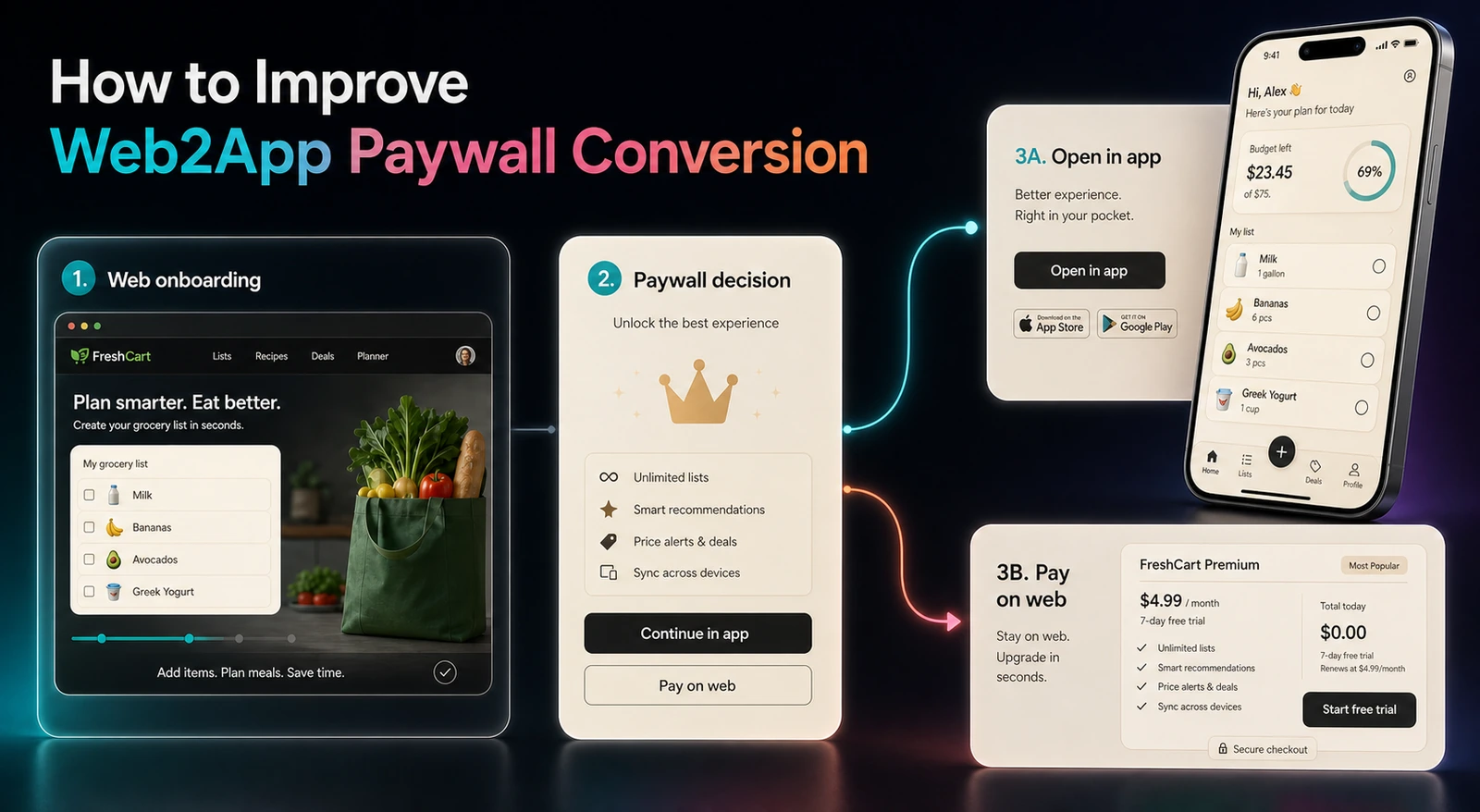
For app-to-web, there is a compliant pattern that converts. Two CTA buttons: the main one just says Continue or Start My Free Trial, with smaller text below like "complete purchase in-app instead," since Apple requires you to offer in-app purchase. The web option opens the real browser rather than a web view inside the app, which keeps you on the safe side of Apple's rules.
Two more details make it work. Do not drop people straight onto a paywall after sending them out; rebuild a short onboarding first so the handoff feels cohesive and you can rebuild intent. And ship Apple Pay. Without it, the conversion drop makes the whole thing not worth doing. Philip's reaction to this playbook: it is gold, and it did not exist a year ago.
Key Takeaway
Moving off the App Store is not just a margin decision, it is taking ownership of a retention system you did not build and cannot see. Most of what fails is recoverable: insufficient funds at the wrong moment, an expired card, a bank that said no for no reason. The work is unglamorous, which is why it pays. Cancel failed subscriptions so your account stays healthy, retry on the customer's payday rather than on yours, switch on the settings your processor already offers, and keep one coherent flow from the app to the web checkout.
Resources
Redux Payments: https://www.reduxpayments.com/
Philip Pages LinkedIn: https://www.linkedin.com/in/philip-pages-a881b5139/
Listen to the Full Episode
Youtube
Spotify
Apple Podcasts
Check out past episodes here: PricePowerPodcast.com