 works with
Botsi + web2wave: AI pricing for your web2app funnel
Keep web2wave for your quiz flows, paywalls and payments. Add Botsi to decide which price, paywall and offer each user sees.
Not using web2wave? Book a demo with web2wave
The 10-second answer
web2wave builds and serves your web2app funnel and takes the payment through your own payment provider. Botsi decides which paywall that user should see, a moment before the paywall loads. Nothing in your funnel gets rebuilt: Botsi returns a paywall slug and web2wave routes to it.
You are already paying for this traffic. Botsi does not change how much of it you buy. It changes what each visitor is worth, by deciding which paywall, price and offer that one person sees.
Your quiz asks a dozen questions, then shows everyone the same price
A web2app funnel does something most apps never get to do. It asks. By the time a user reaches your paywall they have told you their goal, their experience level, how fast they want results and what they have already tried. That is a real profile, given willingly, one screen at a time. Then the funnel ends, the paywall loads, and unless you hand-built branching for it, every one of those people sees the same offer at the same price. Say it is $39.99 a year. The quiz asked a dozen questions and then ignored every answer at the exact moment the money was on the table.
That single price is wrong in two directions at once. One user arrived from cheap traffic, picked the least urgent goal and has never paid for an app like yours. For them $39.99 is enough friction to end the session, and you get nothing back from traffic you already paid for. Another told you they have a deadline in six weeks and has already tried two paid alternatives. They would have paid more without hesitating. You lose the first one and you discount the second for free.
A/B testing narrows this, it does not solve it. You split traffic, wait for significance, and the winner is whichever variant produced the best result on average. Average is the problem. The variant you kill is usually the right screen for some real slice of your users, and the one you keep is wrong for a different slice. You end up with a single compromise price, tested properly, that fits almost nobody exactly, while the profile your quiz just collected goes unused at the one screen where it is worth the most.
Who runs what
There is no overlap to argue about. web2wave owns the funnel and the money. Botsi owns the decision.
Builds and runs the funnel
- Quiz flows and quiz screens, built no-code in their drag-and-drop editor
- Paywall design and hosting
- Web payments through your own payment account, on your own processor
- Cancellation flows and 1-click unsubscribe
- Attribution, deferred deep links and ad pixels
- AI localization and user CRM
Decides what each user sees
- Which of your paywalls a given user should land on
- Which price and offer that paywall carries
- A per-user prediction built from quiz answers, geography, device and traffic source
- Continuous learning as real purchases come back in
- Web revenue reported next to your App Store and Play Store revenue
What apps running both see
+20%and higher
LTV lift for apps running Botsi with web2wave.
That is what Botsi measures across apps running both, not a number Botsi promises you. Your quiz, your traffic mix and your price points all move it.
What stands behind it
It keeps learning after launch. Every confirmed purchase comes back through the web2wave webhook and feeds the model, so the decision sharpens while the funnel runs instead of freezing on day one.
You can see it in the reports you already read. Botsi maps web2wave subscription states onto the same event taxonomy as mobile, so web revenue lands next to your App Store and Play Store revenue instead of in a side channel.
Curious where your own funnel would land?
What Botsi is, if you have never heard of it
Botsi is an AI pricing model. It is not a funnel builder, not a paywall editor and not a payment processor. It is trained per app, on your own data, and it answers one question: given everything known about this person right now, which of your paywalls should they see. You build the paywalls in web2wave. Botsi picks between them, one user at a time, a moment before the page loads.
In practice you keep a small set of paywalls: a standard annual, a higher tier, a longer trial, a discounted entry point. Botsi chooses between them. Every price on the table is a price you wrote and approved, so there is no scenario where a user is shown something you did not intend. The model chooses inside your boundaries, never outside them.
The mechanics are deliberately boring. The quiz answers you already collect, plus geography, device and traffic source, reach Botsi as custom attributes. Just before the paywall step, Botsi returns the slug of a paywall you already built, and web2wave routes the user to that page and serves it as it always has. No new rendering layer, no flash of the wrong price, and no rules engine for you to maintain: there is no segment spreadsheet and no if-country-then-discount logic sitting in your head waiting to go stale.
Then it learns. Every trial, purchase, renewal and refund is confirmed back to Botsi by webhook, so the model updates on what people actually bought instead of on a test result somebody has to read and act on. Apps running Botsi with web2wave see LTV lifts of 20% and higher. Nothing upstream changes. The decision at the end does.
How Botsi gets paid matters here, because it changes what that number is worth to you. Botsi costs a fixed monthly amount, on public brackets that start at a $399 tier, and it comes with a Risk-Free Performance Guarantee. It is never a share of your revenue and it is never in your checkout. Payments keep running through your own payment account inside web2wave, and Botsi only learns that a purchase happened after the fact. Whatever the model adds stays with you.
What happens in the funnel
Five touchpoints, all inside the flow you already built. Botsi never renders a screen: it answers one question, and web2wave does the rest.
Quiz start
A Botsi profile is created
web2wave's user_id becomes the customerUserId on the Botsi side, so every later event lines up against one person.
Quiz complete
Answers sync as custom attributes
The answers you already collect, plus initial URL and geography, become the signal Botsi predicts from. Better quiz, better prediction.
Before the paywall
Botsi returns a paywall slug
Botsi picks from the paywalls you built in web2wave and hands back the slug. web2wave routes the user to that page. No new rendering layer, no flash of the wrong price.
Paywall shown
The impression is logged
Botsi records which paywall was served and whether it came from the model, which is what makes the result measurable rather than anecdotal.
Purchase
web2wave and your payment provider take the payment
Money moves exactly as it does today, through your own account. A webhook confirms the transaction back to Botsi so the model learns from it.
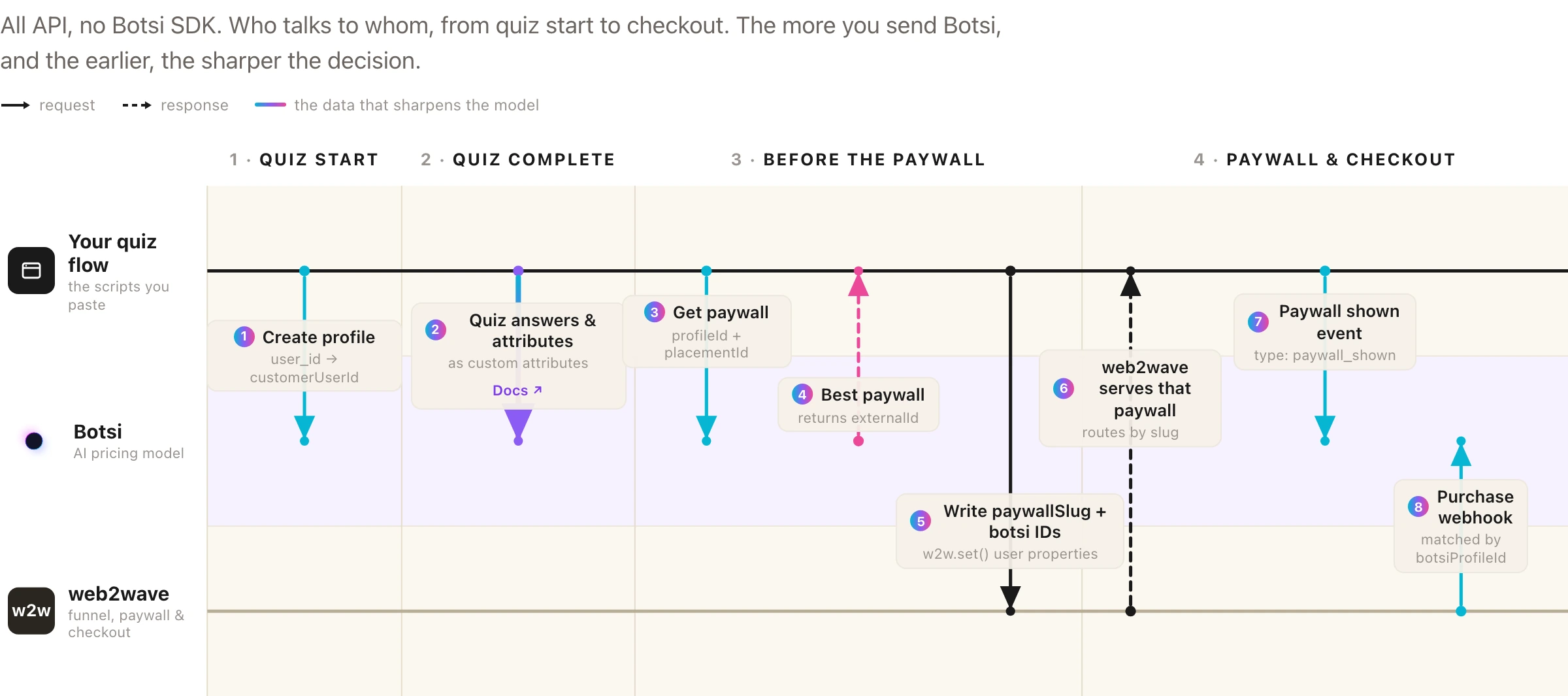
The signal is already in your quiz. Botsi predicts from the answers you collect today, plus initial URL, geography and device. There is no new data to start collecting: the integration reads answers your flow already captures.
Not sure which of your quiz answers are worth sending as signal?
Why a quiz funnel is the best input a pricing model can get
Most apps give a pricing model very little to work with. Someone installs, and the model sees a country, a device, an install source and a timestamp. From that it has to infer what the person wants and what they will pay. It works, but it is inference on thin evidence. A web2app funnel is the exact opposite. The user answered a dozen questions before any price appeared, and they answered carefully, because those answers shaped the plan the funnel promised them.
Look at what a typical quiz has captured by the time the paywall loads. The goal the person chose. Their experience level. How urgent it is, sometimes down to a target date. What they tried before and what failed. Age band, region, language. Which ad brought them in. In pricing terms that is intent, urgency and price sensitivity, the three things every other app is guessing at.
That is why this pairing is stronger than the same model attached to a plain mobile app. Botsi is not reading a country code and hoping. The person who said they have failed at this twice and wants a result in thirty days is not the same buyer as someone poking around out of curiosity, and your funnel already knows the difference. It just was not using that at the paywall.
The practical version is simple. The better your quiz, the better your pricing gets. Every question you added to personalize the flow doubles as evidence for the decision at the end, so you are not collecting anything new and there is no minimum set to start with. Same questions, same screens, same drop-off curve. The funnel you already built is the input. The paywalls you already designed are the options.
What stays exactly where it is
Adding Botsi is additive. Nothing you built in web2wave moves, and nothing about how you get paid changes.
Your funnel
Quiz flows, screen design and paywall layouts stay in web2wave. Botsi chooses between the paywalls you have already built.
Your money
Payments stay in your own payment account, billed through web2wave exactly as they are today. Botsi never touches funds and never sits in the checkout.
Your compliance work
Cancellation flows and 1-click unsubscribe stay where they are, in web2wave.
Your subscription stack
web2wave's existing syncs to your subscription platform keep running. Botsi sits upstream of all of it.
Your measurement
Attribution, deep links and ad pixels keep firing exactly as configured.
Botsi is a fixed monthly bracket. It starts at a public $399 tier, it is never a share of your revenue, and it carries a Risk-Free Performance Guarantee.
Already running a web2wave funnel?
Get an estimate of what per-user pricing could add on top of the funnel you have today.
web2wave is built into Botsi
Not a workaround. web2wave is a store Botsi understands natively, with its own settings and its own place in your reporting.
web2wave has its own place in the product
web2wave is a recognized billing source in Botsi, alongside the App Store, Play Store and direct Stripe. It is not a generic webhook you have to design yourself: the receiving end already exists, and Botsi knows what a web2wave transaction means when it arrives.
Its own tab in App Settings
There is a dedicated web2wave tab in Botsi. On the Botsi side it is one required field. You paste the webhook secret from web2wave, then copy the webhook URL Botsi generates back into your web2wave project.
Web revenue lands in the same reports
Botsi maps web2wave subscription states onto the same event taxonomy as mobile: trial started, trial converted, renewal, renewal cancelled, billing issue, grace period, pause, refund. Web revenue shows up in your charts alongside App Store and Play Store revenue, not in a side channel.
Product mapping is one field
Create the product in Stripe, sync it into web2wave under Plans and Prices, then paste that Stripe price ID onto the Botsi product as the web2wave product ID.
You will be able to tell whether it worked. Botsi records which paywall was served and whether the model chose it, so what you have at the end of the month is a measured difference and not a story.
The setup guide has every step written out.
Built together
How to Improve Web2App Paywall Conversion
A co-marketing post with web2wave: 14 tested tactics for lifting web2app paywall conversion, from per-day pricing and intro offers to downsale sequences and payment orchestration.
Questions teams ask
What comes up before pairing Botsi with a web2wave funnel.
Does Botsi replace web2wave?
No, and it could not. Botsi does not build quiz funnels, design paywalls or process payments. web2wave does all three. Botsi answers a different question: given everything known about this specific user, which of your paywalls should they see. The two products do not overlap, which is why they run well together.
Does this replace web2wave's A/B testing?
It runs alongside it. An A/B test splits traffic between variants and tells you which one wins on average. Botsi picks per user, and keeps picking as results come back, so a paywall that only wins for one segment can still be used for that segment instead of being discarded. Plenty of teams keep using web2wave testing for layout and copy while Botsi handles price and offer selection.
Do I still use my own Stripe account?
Yes. The documented setup runs on Stripe: you create the product in Stripe, sync it into web2wave, and the money lands in your own account exactly as it does today. Botsi never handles funds and is never in the checkout path. It learns that a purchase happened from the webhook web2wave sends after the fact.
What data does Botsi need from the quiz?
Whatever you already collect. Quiz answers get sent as custom attributes, along with the initial URL, geography and device. There is no minimum set. More signal generally means a sharper prediction, but the integration works with the properties a standard web2wave flow already carries.
How much work is the setup?
It is a real integration, not a toggle. You exchange webhook details between the two dashboards, add Botsi's user properties to your web2wave project, map your products, and insert the Botsi Web-API scripts at four points in the quiz flow. The setup guide walks through each step with the scripts ready to paste.
We already run a subscription platform alongside web2wave. Does that conflict?
No. Entitlement and subscription-state tools sit downstream of the decision Botsi makes. Whatever web2wave already syncs to keeps running, Botsi runs upstream of all of it, and nothing in your entitlement stack has to move.
Who builds and maintains this integration?
It is built and maintained by Botsi, using web2wave's own webhook and user-property system together with the Botsi Web-API. web2wave is a first-class store in Botsi's product, and the full setup guide is published in the Botsi docs. If you want it configured with you on the call, book a demo and we will walk your flow.