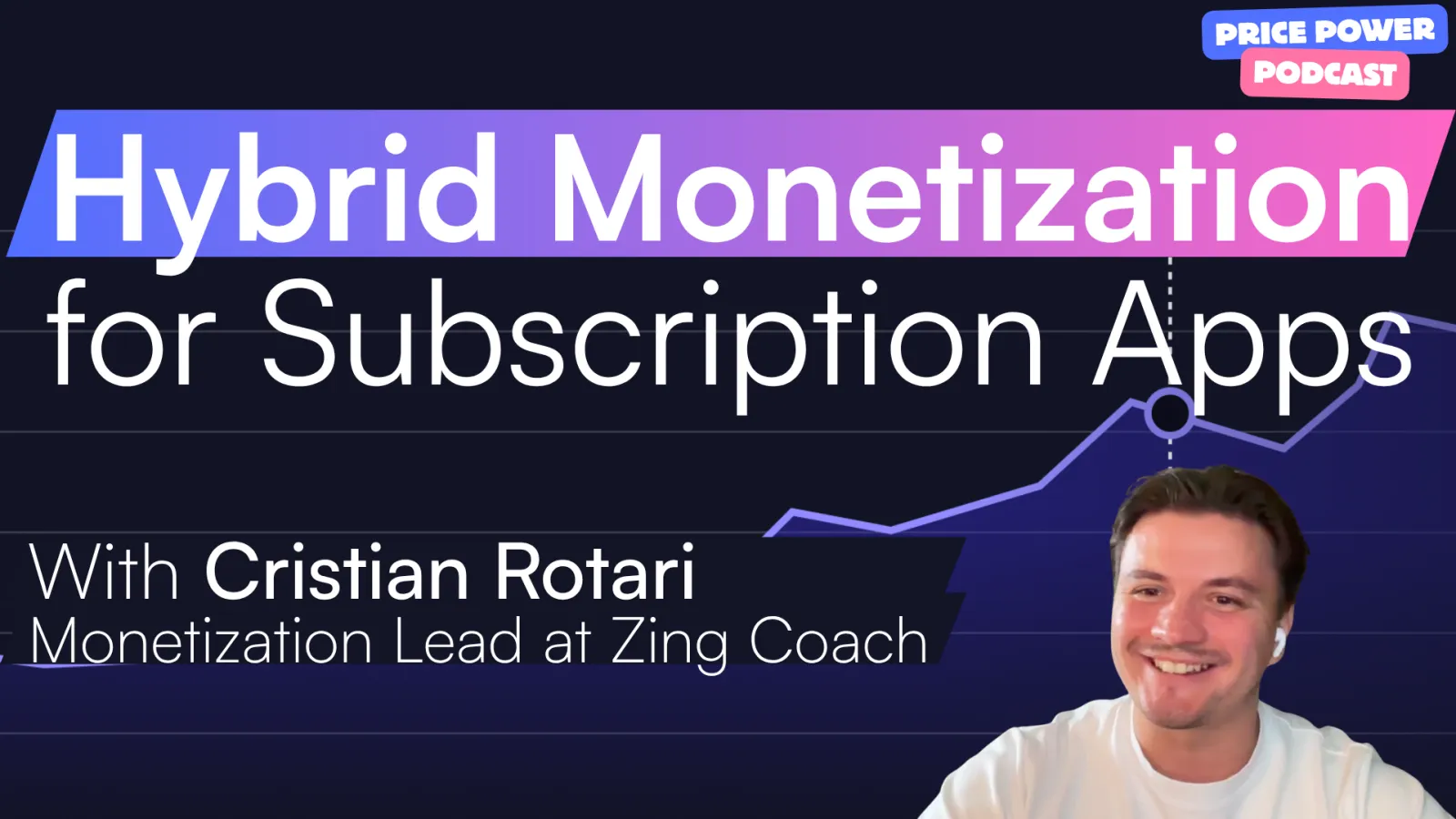
Cristian Rotari is the Monetization Lead at Zing Coach, an AI fitness app, and was previously a growth product manager at Lingokids. He has spent years running price tests, building upsell portfolios and advising other subscription apps, so most of what follows comes from hard-won experience rather than theory. He joins the Price Power Podcast to talk through hybrid monetization: how subscription apps layer in-app purchases, ads, affiliates, physical products and partnerships to capture revenue across the full willingness-to-pay spectrum, and how to do it without one stream eating another.
Ten Tips from the Episode
1. Treat willingness to pay as a spectrum, not a yes or no

The core idea Cristian picked up from Thomas Petit at Lingokids is the demand curve. A subscription has one price, so it reads willingness to pay as binary: someone paid or they didn't. Real demand is spread across a wide range.
At one end you have whales, users who will buy almost anything you offer. At the other you have plankton, who will never convert no matter what you do. A single price leaves money on the table at both ends. It underprices the whales and ignores the plankton entirely.
Once you see your users this way, hybrid monetization stops being a buzzword and becomes a tool. You add layers to get more from the whales and to find some middle ground for the plankton.
2. Freemium is what unlocks everything else
Zing Coach started with a hard, barely skippable paywall and no trial at all. The barrier to entry was the blocker. When the team eased the paywall and added a trial, the user base grew, especially among people who were not ready to pay yet.
Those users matter for two reasons. They are who hybrid monetization is for, and a bigger base drives more word of mouth. If you have already figured out how to convert people, moving from a hard paywall to a soft one costs you only a couple of points of start rate while opening up far more growth.
Cristian's read on the market: roughly 95% of very large apps run on a freemium model. The hard paywall caps how big you can get.
3. Hybrid is not a day-one decision
This is not a day-zero or even day-one move. First you nail product market fit and one monetization model, usually subscriptions. You optimize pricing and packaging until you hit a ceiling. Only then, once you understand your users well enough to segment them, do you add a second layer.
Trying to run multiple monetization models before you have nailed one is how you end up with a confusing product and thin results.
4. Start with in-app purchases, not ads

When you do add a layer, Cristian recommends starting with in-app purchases for most apps. They slot in alongside your existing subscription, run through the same Apple and Google billing you already manage, and use paywall mechanics your team already understands.
Ads are a different beast. They are a volume business and they are not easy to manage. For most apps, IAPs are the easier and more profitable first step.
5. Ads only pay off with volume and frequency
Founders see games minting money from ads and assume they can do the same. The catch is that ads need high daily active users and long sessions so you can show multiple high-value impressions every day.
Most subscription apps do not have that profile. A workout app gets opened once or twice a week for a few minutes. That is not enough volume. Cristian has run the numbers, and for smaller apps, ads almost always lose to in-app purchases.
When ads do work, it is usually because the app places them around core actions. Duolingo runs an ad after each short lesson. Flightradar makes you watch a 15 to 20 second ad before it tells you which plane is overhead. The product is engaging enough that people tolerate the friction, and that same friction nudges them toward paying to remove the ads.
6. AI apps have to think about cost from day zero
AI apps are the exception to the "go slow" advice. Every action carries a real marginal cost. Cristian describes founders who open a free trial and wake up to find a single power user has burned thousands of dollars in tokens overnight. Image generation is even worse than text.
At Zing Coach, the AI coach runs on the OpenAI API, so the team had to model how much a free or trial user could use it before hitting a wall. For these apps, credits and usage limits are the status quo, not a later add-on. As Cristian puts it, if you are an AI app with generation, you do not think about it as hybrid monetization. You just need credits from the start.
7. Add affiliate revenue with a single link
Affiliate is one of the lowest-effort streams to test. You do not need a special platform. An Amazon affiliate link is just a URL with an appendix that pays you if someone buys through it.
The catch is fit. The products have to extend your core value without cannibalizing anything inside the app. Cristian points to Lovi, a skincare app that scans your face and recommends rated products through affiliate links. Spotify could recommend concerts or merch from your favorite artists. If Spotify recommended baby products, it would feel wrong. The link has to make sense for the user.
8. Physical products are brand extensions for existing fans

Standing up an online store is far easier than it used to be. Products never have to touch a warehouse you own; third parties handle fulfillment. Zing competitor BetterMe sells Pilates and yoga equipment and branded clothing. Lingokids sells a branded memory game for offline play. AllTrails runs a shop that emails you about new backpacks.
The honest read: these products mostly sell to people who already use and trust your brand. That is fine. It is a clean way to keep monetizing your existing base, as long as the product connects to how people already use the app.
9. Sell more to the people who already paid
This is the tip most likely to change how you operate. The instinct is to chase free users who declined a subscription by offering them something cheaper. Cristian's data says the opposite.

A subscriber, especially a yearly-plan buyer, has shown high intent. Their wallet is already out. At Zing Coach, about 40% of yearly-plan buyers convert to at least one upsell, and that rate drops as you move to shorter plans and lower intent.
Free users who said no have low willingness to pay. Sell them a $25 nutrition guide and the follow-on subscription offer suddenly looks expensive, so they buy neither. The rule Cristian uses: promote subscriptions to non-subscribers, and promote upsells only to subscribers. Monetize the intent you already have instead of leaving it unattended.
10. Tiers need a value ladder, not a feature pile
Subscription tiers are related to hybrid but can clash with it. Pile on pro and premium tiers alongside IAPs and affiliates, and you create a UX mess and a muddy value message.

The fix is segmentation. Spotify does not sell pro versus premium. It sells individual, family, student, dual: tiers built around how people actually use the product. Dating apps tier by usage intensity, like boosts and super likes, and nobody expects those in the base plan because the value ladder is clear.
Cristian's rule: never put something in a higher tier that users expect in the base plan, and never strip the base to build a tier. You add value on top. At Zing Coach, a personalized workout plan sits above the base because it carries a real extra cost and only some users want it.
Key Takeaway
Hybrid monetization is not a pile of extra revenue streams, it is a way of serving demand you can already see but cannot currently charge for. The sequence matters: get to product market fit, make one model work, ease the paywall enough to have a base worth monetizing, then add in-app purchases before you touch ads. And route every offer by intent, because the person most likely to buy again is the one who just bought.
Resources
Zing Coach: https://www.zing.coach
Cristian Rotari LinkedIn: https://www.linkedin.com/in/cristianrotari/
Listen to the Full Episode
Youtube
Spotify
Apple Podcasts
Check out past episodes here: PricePowerPodcast.com