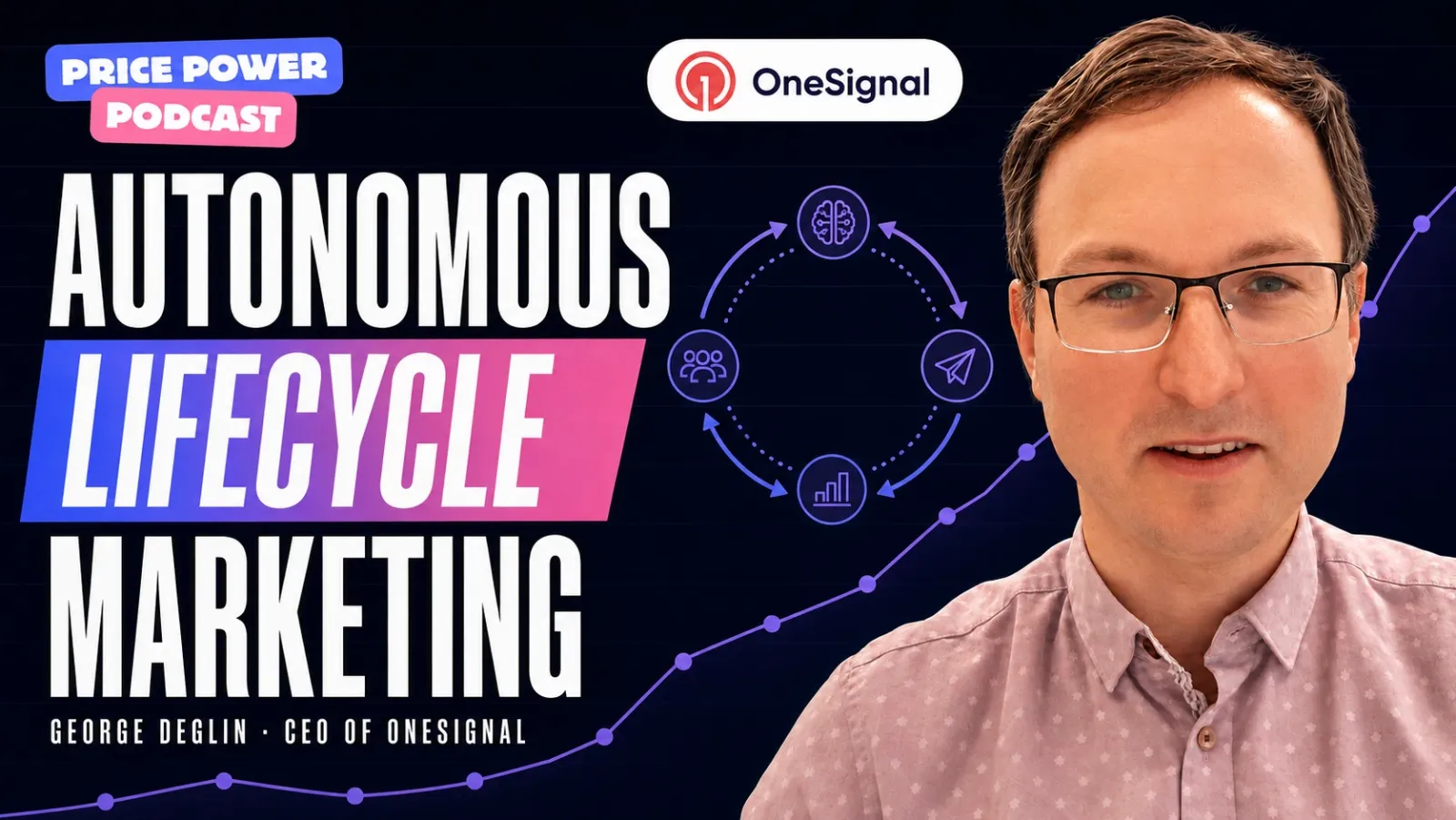
George Deglin is the CEO and co-founder of OneSignal, which handles messaging for a large slice of the subscription app world. He joins the Price Power Podcast to explain why calendar-based lifecycle marketing is the single biggest thing holding subscription apps back, why he wrote that dashboards are dying, and what an autonomous lifecycle marketing agent actually looks like in practice.
Ten Tips from the Episode
1. Move your sends off the calendar and onto behavior
This is the number that should reorder most teams' roadmaps: behavioral triggered messages perform 4x to 9x better than scheduled sends.
Most lifecycle programs still run off a marketing calendar. Before any team invests in AI-generated one-to-one copy, the higher-leverage move is converting those scheduled sends into triggered ones, tied to something the user actually did: a product they viewed, a level they reached, an action you want them to take.
2. Email is the most underinvested channel in consumer apps
Apps pour effort into push and neglect email, even though email is the only channel that still reaches someone after they have uninstalled the app.
George's framing is uncomfortable: companies spend heavily on paid win-back campaigns while ignoring a channel that costs almost nothing to send. The barrier is organizational rather than technical, because email usually requires product and marketing to work together.
3. Lifecycle marketing is an extension of the product
The apps that win tie messaging to the product experience rather than running it on a separate schedule. The ones that struggle have a silo between the product team and the lifecycle team, and that silo shows up directly in message quality.
The related question is ownership: when retention and LTV belong to nobody in particular, lifecycle work drifts toward whoever has calendar space rather than whoever understands the user.
4. Paid media crowds out cheaper retention work
Paid acquisition is measurable, urgent and politically easy to fund, so it becomes a myopic focus. The cheaper retention work loses out, not because anyone decided it was less valuable, but because it never competes for attention on equal terms.
5. Know the difference between personalization and segmentation
Most of what teams call personalization is segmentation with a first name merged into the subject line. Real personalization means the content itself changes based on what this specific person did.
George carves out Amazon as a genuine exception, where the behavior and product taxonomy really are complex enough to need one-to-one. For almost everyone else, a well-chosen trigger does more than a model rewriting copy.
6. Most companies chasing ML personalization are optimizing the wrong 5%
Adopting a complex ML personalization system means normalizing your data into a standard taxonomy, running a training pass, and retraining on an ongoing basis. That is a real and continuous operational burden.
As George puts it, that work takes a business from 95% to 100%, but most businesses are not at 95%, and the ones who think they are are usually overlooking basics. Get everything else working first, then spend attention on the last five points.
7. "Dashboards are dying," and the intelligence is not what dies
The provocative line from George's essay is that dashboards are dying, which is a strange thing to hear from someone whose company spent a decade building one.
His argument is not that software becomes a dumb API layer. The differentiation stays in the product logic. What changes is where the user sits: increasingly inside an agent rather than a vendor dashboard. In January he asked roughly twenty customers whether they saw themselves using OneSignal from the dashboard or from inside Claude, Gemini or ChatGPT, and they were roughly split. Six or seven months later he reads the split as having moved toward the agent, partly because an agent can string together intelligence from several tools rather than relying on what any one product knows.
OneSignal now exposes API endpoints for configuration steps it had always assumed people would click through once.
8. The autonomy ladder is a trust ladder
OneSignal builds against a ladder from L0 to L4, and each rung exists so customers can calibrate trust before the next handoff.

The rungs run from Manual, the dashboard where a marketer drives every click and the team scales by hiring, through Assistance, which is live today, to Expert Assist, Agentic Autopilot and finally Full Operator. Each step hands over more: at L3 you delegate bounded work and approve in large chunks, and at L4 you set the goals and the guardrails while the system plans, sends, tests and improves against them.
L4 is the vision rather than the present. The detail worth noticing is that even there, the agent reaches out only when it needs you. Autonomy here is not the absence of a human, it is the agent knowing when it needs one.
9. Hand the agent the work nobody wanted

George describes customers running dozens of apps who would open the first one, copy a number, open the next, copy another, and assemble a report for a manager. An hour a day, every day. Now they ask the agent for the report.
The second-order effect is that people start asking the questions they used to abandon: how to run an email warm-up campaign, how to set up web push for iOS, what the SMS regulations are in Brazil. The bottleneck was never only time, it was expertise.

He does not dodge the headcount question either. Companies may well need fewer people for the tedious parts. His counter is that the tedious parts were never the good work, and that cheaper lifecycle marketing means more companies can afford to do it at all. A 10 to 15% revenue lift cannot justify a hire until roughly a million in ARR, which is why most apps never start.
10. Build features that cost more, because tokens get cheaper
George's hot take inverts how most teams are handling AI margins. Given how fast inference costs fall, anxiety about token spend points the wrong direction: a feature that is expensive today runs at a fraction of the cost a year out, so you are better off leaning into expensive use cases in anticipation of falling prices.
He also argues against charging separately for AI features, comparing it to charging customers because you moved a button to a better place on the dashboard. If AI becomes the default way people use the product, nickel-and-diming it is the wrong instinct.
Key Takeaway
The unglamorous work is where the returns are. A trigger tied to real behavior beats a model rewriting copy on a calendar send, email beats another paid win-back, and getting the basics to 95% beats a personalization system built for the last five points. What agents change is not the priority list, it is who has to do the tedious parts of it, which is why George frames autonomy as something customers hand over one rung at a time rather than all at once.
Resources
OneSignal: https://onesignal.com
George Deglin LinkedIn: https://www.linkedin.com/in/gdeglin
George's essay on autonomous lifecycle marketing: The Future of Lifecycle Marketing is Autonomous
Listen to the Full Episode
Youtube
Spotify
Apple Podcasts
Check out past episodes here: PricePowerPodcast.com