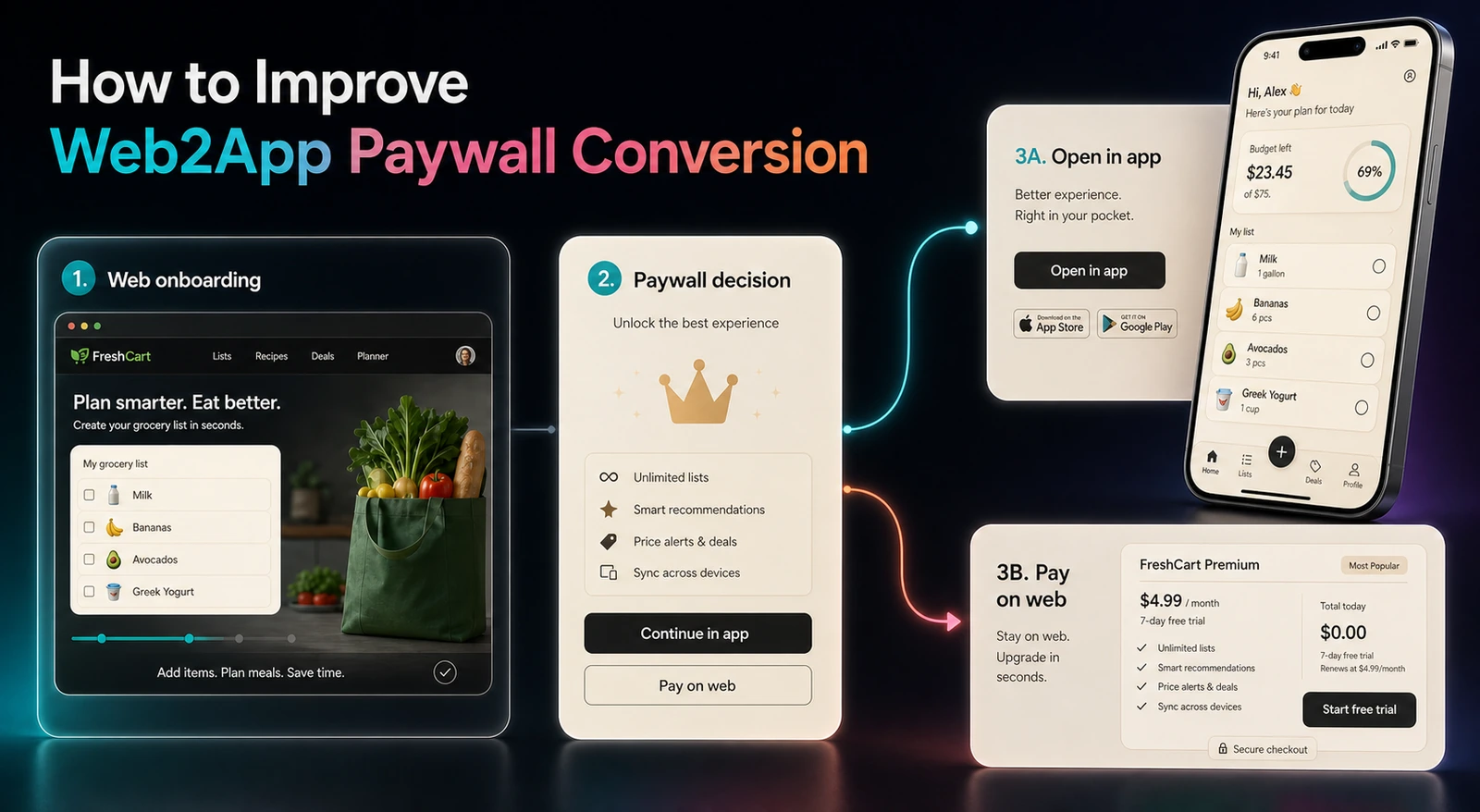
Your onboarding flow is one of the most critical moments in a user's journey. It's where you set expectations, build engagement, and prepare users for conversion. Here are proven A/B tests you can run to improve your onboarding.
Personalization: Ask About User Goals
Instead of a generic onboarding, ask users about their specific goals or preferences. This serves two purposes: it makes the experience feel personalized, and it gives you valuable data about user intent.
Take it a step further by using their goal-based preference in follow-up messaging. If a user selected "get fit," your paywall and in-app messaging should emphasize fitness benefits. If they selected "save money," emphasize the cost savings of your subscription.

Pulling System Data: Apple Health Integration
Apps like RISE Sleep Science ask permission to access Apple Health data during onboarding. This lets you pull in sleep, exercise, or health metrics that personalize the experience immediately.

Users see their own data reflected in the app, which increases engagement and makes the value proposition concrete rather than hypothetical.
Calculating Value in Real-Time
Opal, a focus app, calculates how much screen time the user has saved (based on their usage patterns). This number—"You've saved 2 hours of screen time this week!"—becomes powerful social proof and motivation to subscribe.

Similarly, if you're a fitness app, calculate their estimated calories burned or workouts completed. Make the user's progress visible immediately.
Loading Screens: Turn Waits into Moments

Apps like Flo, JustFit, Imprint, and Zing Coach use loading screens effectively during onboarding. Instead of a blank screen, they show tips, testimonials, facts about their product, or upcoming features.
A 2-3 second loading screen is an opportunity, not a problem. Test different loading screen content (tips vs. reviews vs. success stories) to see what resonates most.
Social Proof: Testimonials, Reviews, and Ratings

Include user testimonials and app store ratings throughout your onboarding. This reassures new users that others like them have found value.
Test different types of social proof: recent reviews (shows momentum), user testimonials with photos (increases credibility), or large app store ratings (provides authority). See which converts best for your users.
SSO: One-Tap Authentication
Add "Sign in with Apple" or "Sign in with Google" during onboarding. For users who don't want to create a new password, SSO dramatically reduces friction.
Test the placement of your SSO button. Should it appear before or after email sign-up? Should it be the primary option?
Push Notification Opt-In
Asking for push notification permission is a critical moment. Here are different approaches:
- Imprint's approach: Ask permission immediately, right after sign-up, before showing too much content
- Flo's approach: First explain the value of notifications, then ask permission
- JustFit's approach: Show a few screens of onboarding, build excitement about the app, then ask
- Impulse's approach: Use a "soft prompt" (in-app message) before the native iOS prompt
Test different timings and messaging for push permission. Some users respond better to early asks, others to later in the flow when they understand value.
Continuing Onboarding Post-Paywall
Don't end onboarding at the paywall. Users who convert should still experience an abbreviated onboarding that sets them up for success and shows them premium features.
This "secondary onboarding" for paying users increases feature adoption and reduces early churn. Test different lengths and content for post-purchase onboarding.
Testing Framework
When A/B testing onboarding, measure:
- Completion rate: % of users who finish the onboarding flow
- Time to paywall: How fast do users reach your first monetization moment?
- Conversion rate: % of users who see the paywall and subscribe
- Day 7 retention: % of users still in the app 7 days later
- Day 30 retention: % of users still in the app 30 days later
An improved onboarding might increase time to paywall (users spend more time discovering value) but also increase conversion rate and retention. The right metric depends on your business model, but we generally care most about retention and lifetime value.
Conclusion
Your onboarding is prime real estate for testing. From goal-based personalization to push permission timing, there are dozens of elements you can optimize. Start with one test at a time, measure impact on key metrics, and iterate. Over time, these small improvements compound into significantly higher engagement and monetization.